Client Case:
- Construction — Glazing, Windows & Doors
- NSW — Sydney Metropolitan Area
- Small (6-20)
- First Certification
- $1M-$5M
From Locked Out to Certified: How a Sydney Glazing Firm Unlocked Government Contracts Without Adding HeadcountISO 9001 certified first attempt. Zero non-conformities. Zero new hires. The business process became the management system.
The Situation
Company Background
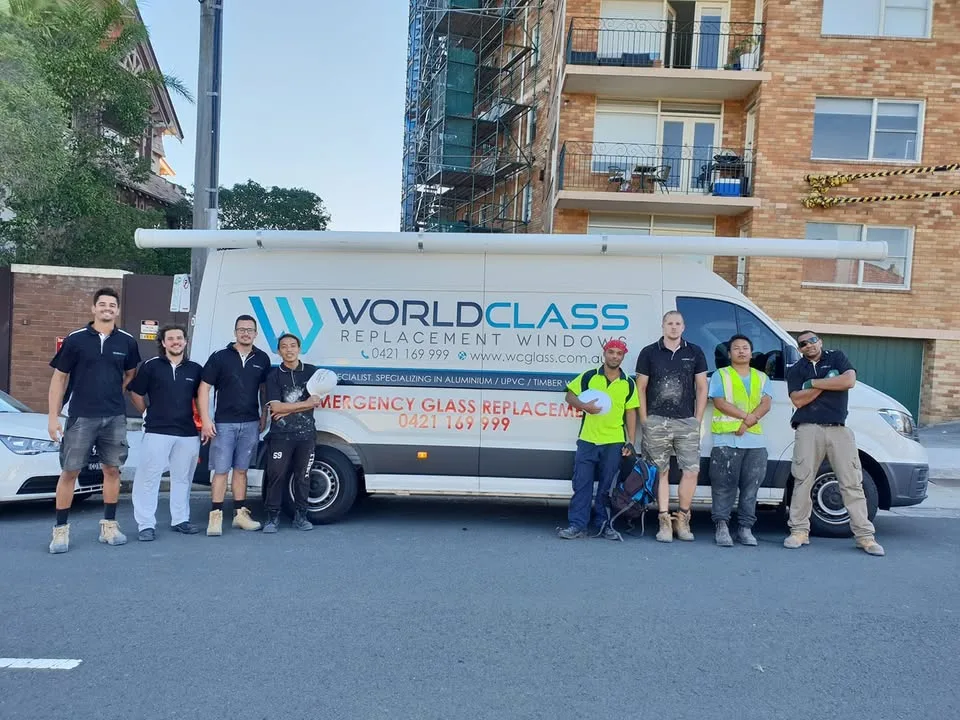
The Managing Director started World Class Glass years ago as a one-man operation — quoting jobs, cutting glass, installing frames, sweeping the site, and sending the invoices himself. Every dollar the business earned came from his own hands.
Over time, the work grew. One reliable installer became two. A small office took shape. The reputation spread through word of mouth — builders across Sydney who knew that when World Class Glass quoted a window package, it would show up on time, fit right, and not need a callback.
The company grew from the MD and a ute to a proper operation. Glazing, windows, doors — commercial shopfronts, residential replacements, mid-size packages for builders across the Sydney metropolitan area. Revenue settled between $1.5M and $3M annually. The core team was 5–10 fixed employees, supplemented by specialist subcontractors when larger jobs demanded it.
By this point the MD had stepped off the tools. He no longer cut glass or hung doors. His days were spent running the business — quoting, scheduling, negotiating with suppliers, keeping builders happy, chasing payments, coordinating crews. He’d built something real. But the business still ran through him. Every decision, every approval, every problem landed on his desk.
There was no formal management system. Quality was managed through the standards he’d set when it was just him on the job, passed down to a crew who’d been with him long enough to know what was expected. It worked — until the market started pointing somewhere the company couldn’t follow.
Internal Context
Inside the business, the weaknesses were structural and compounding.
Everything depended on the MD. If he was on site, quality was high. If he wasn’t, standards drifted. There were no documented processes — just tribal knowledge passed from the founder to whoever happened to be around long enough to absorb it. When the MD took a day off or got stuck in a meeting, nobody could make a decision without calling him.
Rework was invisible. Callbacks, warranty fixes, remakes, and site returns were absorbed as “just part of the job.” Nobody tracked the cost. On an estimated 8–10% of project value, that was $160,000–$200,000 per year disappearing into work that generated zero revenue.
Subcontractor quality was inconsistent. The MD used the same three or four subcontractors, but there was no formal evaluation, no performance tracking, and no documentation behind the decision to use one over another. When a subcontractor delivered poor work, the conversation happened once and was forgotten.
Cash flow was unpredictable. The private market meant builders routinely paying 90–120 days late. One cancelled window package or one builder going into administration could put payroll at risk against the glass supplier’s account.
There was no prequalification capability. Nothing to submit to government panels. Nothing to show a Tier 1 builder doing due diligence. The company’s quality story existed only in the MD’s handshake and reputation — both invisible to any procurement process.
Market Context
Outside the business, the market was shifting in a direction that made these internal weaknesses existential.
Private-sector construction across Sydney is cyclical and fiercely competitive. For a small glazing firm, there is no forward visibility — you quote, you wait, you win some. Good quarters followed by quiet months. Revenue depends entirely on which builders are active and which projects are running.
Meanwhile, government building work across NSW was accelerating. Schools, hospitals, social housing, transport hubs, correctional facilities. $278 billion in government infrastructure expenditure across all jurisdictions over four years. The NSW government alone was one of the largest contributors. These projects offered something the private market never could: milestone-based payment schedules governed by Security of Payment legislation. Predictable cash flow. Forward visibility. The ability to plan.
But there was a gate. In New South Wales, contractors bidding for government construction contracts over $1 million must hold an independently certified quality management system compliant with AS/NZS ISO 9001. Without it, World Class Glass couldn’t even submit a tender. Not rejected on price. Not rejected on capability. Rejected at the door.
The MD’s competitors were already through that gate. At least two firms he knew had been certified in the past eighteen months. They were building prequalification records on government panels he couldn’t access. Even in the private market, the ground was shifting — Tier 1 builders were starting to include ISO 9001 certification as a subcontract requirement. The market wasn’t just moving. It was closing behind him.
Risks and Opportunities
Main Risk/ Opportunity:
Excluded from $242B government construction pipeline — no ISO 9001 certification
Other Risks and Opportunities:
Government contracts offer milestone-based payments and forward pipeline visibility — the cash flow stability private work can't provide
Competitors already certified are accumulating prequalification records on panels World Class Glass can't access
Tier 1 private builders increasingly requiring ISO 9001 from subcontractors — the private market itself is closing
Certification would unlock revenue diversification, breaking the feast-or-famine cycle of private-only work
Context Barriers
Main Barrier:
Every path to ISO certification required hiring a dedicated quality person at $75K–$100K/year — a third of net margin before winning a single government contract
Other Barriers:
Implementation consulting fees: $10,000–$30,000+
A dedicated quality coordinator fully loaded at $75,000–$100,000/year — every consultant said this was non-negotiable
Surveillance and recertification audits: $5,000–$8,000/year ongoing
Total 3-year cost under the traditional model: $250,000–$350,000
Template-based implementations passed audit but gathered dust within six months — the system died the moment the consultant left
Partnering under a larger firm's certification meant surrendering margin, client relationships, and operational independence
The Intervention
Diagnosis
The MD found backup.9001.plus and for the first time, someone showed him why every quote he’d received was built on a flawed design — not a flawed budget.
Every other consultant approached ISO the same way: build a quality management system as a separate structure, bolt it onto the side of the business, and hire someone to maintain it. That design choice — the system existing as a parallel universe to the business — is the root cause of every problem the MD had heard about.
The system dies when the consultant leaves because it was never connected to the business in the first place. A dedicated person is required not because ISO demands it, but because the system was designed badly enough to need a full-time caretaker. The documentation gathers dust because it describes an idealised process that nobody actually follows. And the $250,000–$350,000 cost isn’t the cost of ISO. It’s the cost of a poorly designed implementation.
backup.9001.plus works from a different premise entirely: the management system is not separate from the business. It IS the business. The company’s actual operations — how work gets quoted, how materials get procured, how jobs get scheduled, how quality gets checked, how problems get fixed — those processes, when properly structured and formalised, already satisfy the requirements of ISO 9001. The standard doesn’t require a parallel system. It requires a managed one.
This is the difference between compliance and management. A compliance-driven implementation creates a system that satisfies an auditor. A management-driven implementation creates a system that runs the business — and the auditor is satisfied as a consequence.
Phase 1: Strategic Level - Management by Guidelines
- Weeks 1–8
The MD defined where his business needed to go and what gaps stood in the way — those gaps became the system’s strategic anchors
The first phase addressed the strategic level: where is the business going, what are the gaps between where it is and where it needs to be, and what does management need to govern in order to close them?
The MD already knew the answers. Government work. Cash flow stability. Revenue diversification. Reduced dependence on his personal presence. But none of this was formalised, measured, or tracked. His strategic direction existed as intuition — felt but not structured.
backup.9001.plus worked with the MD to translate those instincts into explicit strategic gaps — the measurable distance between current performance and the level required to compete. Revenue concentration (100% private, 0% government). Cash flow volatility (no forward visibility past 60 days). Rework rate (estimated 8–10%, not measured). Operational dependence (single point of failure). Prequalification capability (none).
Each gap became a breakthrough goal with a measurable target and a timeframe. These weren’t quality objectives in the ISO sense of the word — they were business objectives that the management system existed to achieve. The quality policy was written in the MD’s own language, reflecting the company he was building, not the standard he was certifying against.
The management review — the single most important mechanism in the system — was built around these gaps. Previously, the MD did an informal monthly review of jobs and margins. Now it became a structured decision-making session: are the gaps closing? What’s working? What’s not? Where do we redirect effort? The MD didn’t delegate this to a quality manager. He ran it himself — because governing the strategic direction of the business is the MD’s job, and the management review is simply the mechanism for doing it systematically.
Phase 2: Tactical Level - Guideline Deployment
- Weeks 5–18
The MD’s strategic goals were cascaded into the operations — every process, every role, every target connected to the direction he’d set
The second phase addressed the tactical level: how do the MD’s strategic goals flow down into the company’s actual operations? How does the estimator’s quoting process connect to the goal of winning government work? How does the installer’s site check connect to reducing rework? How does the office coordinator’s supplier tracking connect to subcontractor accountability?
This is the deployment layer — the bridge between what the MD decides at the top and what the team executes on the ground. Previously, this bridge didn’t exist. The MD made decisions, communicated them verbally, and hoped they were followed. When they weren’t, he went on site and fixed it himself.
backup.9001.plus mapped every core process as it actually worked — not how a generic ISO template imagined it should work. Quoting. Procurement. Scheduling. Installation. Defect management. Client handover. Supplier evaluation. Each process was documented with the people who did it, in language they used, reflecting the workflow they already followed. Where gaps existed — no corrective action process, no formal supplier evaluation, no risk assessment on project delivery — they were filled.
The targets set at the strategic level were deployed into each function. The estimator got targets around tender success rate and margin accuracy. The lead installer got targets around first-time pass rate on ITPs. The office coordinator got targets around documentation turnaround and supplier performance data collection. Nobody received abstract “quality objectives.” Each person received targets that connected their daily work to the company’s strategic direction.
The team didn’t learn “ISO requirements.” They were trained on their own processes, now formalised. The lead installer learned how his existing site checks fitted into the inspection and test plan. The office coordinator learned how her job tracking system was now the quality records system. The subcontractors received clear expectations and a formal evaluation framework for the first time.
Phase 3: Operational Level - Daily Work Routine Management
- Weeks 9–24 (incl. certification audit)
Every person kept doing their job — their job just became part of a stable, standardised system that didn’t need the MD to hold it together
The third phase addressed the operational level: how does the daily work of the business produce stable, predictable, repeatable results — without depending on the MD’s personal oversight?
This is the foundation. No strategic goal holds and no process improvement sticks unless the daily routine is standardised. The principle is absolute: there is no management without standardisation. The traditional ISO consultant skips this entirely — they produce documentation but never stabilise the operation. That’s why systems die after certification.
backup.9001.plus embedded quality responsibilities into existing roles, not stacked onto a new one. The lead installer owned quality on site — because he already did. His sign-off on an inspection and test plan wasn’t new work; it was the formalisation of a judgement he was already making every time he finished a window installation. The office coordinator managed documentation — because she was already filing job sheets, purchase orders, and delivery dockets. Her role didn’t change. It just became part of the system.
Inspection and test plans were created for each job type — commercial shopfront, residential replacement, mid-size builder package. Work instructions covered the critical operations: glazing installation standards, measurement verification before ordering, material handling and storage. Document control was built around the tools the office already used. Training records and a competency matrix were established for all fixed employees and regular subcontractors.
The daily operation was stabilised using the SDCA cycle — Standardise, Do, Check, Act. First, define the standard for each critical process. Then execute against that standard. Then check whether the result matched the standard. Then act on any deviation — either correct the process or update the standard. This is how the routine becomes self-sustaining: the team doesn’t need the MD to tell them what “good” looks like, because the standard tells them. And when something goes wrong, the corrective action process catches it, traces the root cause, and prevents recurrence.
Internal audits were conducted by existing staff. The system was designed so that the people doing the work could verify the work — without a quality manager standing over them. The certification audit — Stage 1 and Stage 2 by a JAS-ANZ accredited body — found zero non-conformities. Not because the system was perfect on paper, but because it was real. The auditor saw the same processes the team used every day.
The Results
Outcomes
Outcome Summary:
Within twelve months of certification, World Class Glass submitted tenders for government building projects it had previously been locked out of. Schools, hospitals, social housing — projects with predictable milestone-based payment schedules governed by Security of Payment legislation. For the first time, the MD had forward visibility. He could see what was coming three, six, nine months out. He could plan hiring around actual contracts instead of guessing which builder might call next week. He could negotiate material orders against confirmed revenue instead of juggling cash flow month to month.
The management system changed how the business operated day to day. Quoting became more structured — less guesswork, fewer margin surprises, better documentation for tender submissions. Installation quality became measurable for the first time — inspection and test plans gave the crew a clear standard and gave the MD data he’d never had. Defect handling became systematic — problems were recorded, root-caused, and corrected rather than patched and forgotten. Subcontractor accountability was formalised — performance was tracked across jobs, and conversations about quality were backed by data instead of memory.
Documentation went from non-existent to functional — lean, built around the real workflow, maintained by the people who used it. Management review became a genuine decision-making tool — the MD now sat down monthly with structured data on rework rates, tender outcomes, supplier performance, and customer feedback. He made better decisions because he had better information. The system generated the information. The information drove the decisions. The decisions drove the results.
Main Outcome:
ISO 9001 certified first attempt, zero non-conformities, zero new hires — government tender eligibility unlocked
Secondary Outcomes:
Rework costs became visible for the first time and dropped — $60,000–$150,000 in recovered margin annually
Private-sector competitiveness increased — certification differentiated World Class Glass with commercial builders who were starting to require it
Warranty callbacks decreased — inspection and test plans caught problems before handover, not after
Team took more ownership of their work — documented responsibilities and clear standards meant more autonomy, less waiting for the MD
Supplier negotiations improved — performance data from the evaluation register gave the MD evidence-based leverage he never had before
The business became quotable — demonstrable systems, documented processes, and measurable outcomes created value beyond the MD's personal reputation
Leadership Outcome:
For years, the business had run through the MD. Every quality issue, every decision, every client complaint, every subcontractor conversation — all of it landed on his desk because there was no system. Just him. The management system changed that. Not by adding a layer between him and the work, but by giving the existing team a structure they could operate within independently. He still ran the business. But he stopped being the business. He could take a week off and the operation didn’t drift. He could spend a morning quoting new work instead of fixing yesterday’s problem. He could think about where the company was going instead of reacting to whatever was on fire. He’d built World Class Glass with his own hands. The management system was the thing that finally let him step back and let the business run on structure, not personal energy.
The Statistics That Really Matter
$0
Additional headcount required
4–6 months
Kickoff to certification
0
Non-conformities at audit
First attempt
Certification achieved
$60K–$150K/yr
Rework savings per year
$250K+
Saved vs traditional (3yr)
Other Case Studies
Is ISO certification locking you out of the market you need to be in?
backup.9001.plus builds management systems that run your business — not systems that need someone hired to run them. If you're seeing a cost barrier where there should be an opportunity, the problem isn't ISO. The problem is how everyone else implements it.
Related ISO Management Systems Problems